





Venezuela's Top 10 Birding Sites
Birding Hato Cedral
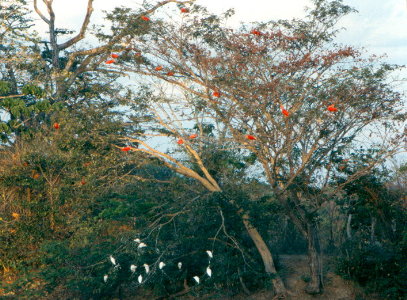
Hato Cedral provides quite a different perspective on the llanos to Hato Piñero. The reason is its location in the low llanos. The forest mosaic and rolling hills of Piñero are entirely absent; here the land is as flat as “further than never again”, to quote Venezuelan writer Rómulo Gallegos. The 53,000 ha ranch consists of flat savannas and open flooded grasslands criss-crossed by creeks. Two major rivers with associated gallery forest cross the ranch. In the wet season, Hato Cedral seems like one large shallow lake and often the main access is by boat. Nesting herons and ibis are a major attraction. In the dry season, the water bodies shrink and wildlife becomes increasingly concentrated in the remaining waterholes. By March the wildlife spectacle is unsurpassed anywhere on the continent.
All the llanos endemics found at Hato Piñero occur at Cedral. With the large extensions of water, waterfowl like Orinoco Sheldgoose and Comb Duck are much easier to find than in the northern llanos, both being all but absent from Hato Piñero. Likewise Agami Herons are much more easily found along the creeks. The avifauna contains fewer Coastal Cordillera elements but more Amazonian-Orinocan species like Zigzag Heron, Amazonian Black-Tyrant and Riverside Tyrant. Yellow-knobbed Curassows are considerably less common and, because there is far less forest than at Hato Piñero, dry forest birds are a shade harder to find. White-naped Xenopsaris is relatively easy and can even be seen at the lodge, together with White-bearded Flycatcher, Yellow-browed Tyrant and a host of other speciality birds.
Specialities and endemics
Full bird checklist
Ascanio, D. and G.A. Rodríguez. 1995. Lista de la Fauna Silvestre del Hato El Cedral, Santuario de Fauna Matiyure, Estado Apure, Venezuela. Sociedad Conservacionista Audubon de Venezuela, Caracas, Venezuela. 304 spp., but now up around 310 spp. 57 pp. Available from SCAV (http://www.audubondevenezuela.org).
(also Llanos: Hato Piñero)