


Venezuelan Ornithology Network (OVUM)
The Venezuelan Ornithology Network (OVUM - Ornitólogos Venezolanos Unidos Milagrosamente!) was conceived at the VI Neotropical Ornithology Congress in Monterrey in October 1999. The founding members were 13 professional biologists with a keen interest in Venezuelan ornithology. As of June 2001 the Network now has 85 members comprising a majority of biologists together with veterinarians, bird tour guides and enthusiastic amateurs. The main interests of members range from ecology and natural history to conservation and taxonomy. Most members are Venezuelan residents, but non-residents are encouraged to join.
Members are linked by a listserver coordinated by Prof. Sandra Giner of the Instituo de Zoología Tropical of the Universidad Central de Venezuela and one of the major activities is information sharing. Regular meetings of the Netowrk members are also held in the Colección Ornitológica Phelps and a regular Ornithology Symposium is being organised, the first having been held in November 2000. The two major topics of this first symposium were the role of birdwatchers in generating information on threatened species and the creation of a Society of Venezuelan Ornithologists.
One of the key roles of the Network is coordination of information on Venezuelan birds and to this effect a Venezuelan Rarities Committee has been set up – see below. Funding is being sought for an annual Venezuelan ornithological bulletin.
Birdwatchers and ornithologists who would like to subscribe to the OVUM Network are invited to contact Prof. Sandra Giner (sginer@strix.ciens.ucv.ve). The Network hopes to create a web page soon.
Venezuelan Rare Birds Committee
The Venezuelan Rare Birds Committee was formed during the First Annual Ornithology Symposium in November 2000. The aim of the committee is to act as a repository of information on rare birds in Venezuela, to evaluate potential new and unusual records and to publicise this information via email, by means of the Venezuelan Ornithology Network (OVUM) and through an annual publication in an existing national journal. The Committee consists of four experts in Venezuelan ornithology who meet on a regular basis to discuss and evaluate recent records.
Species covered by the committee include: a) potential first records; b) species for which fewer than five records exist for the country; and c) nationally and globally threatened species. In addition, the Committee gratefully accepts any other information considered to be unusual, such as early and late dates for migrants, range extensions and unusual behavioural observations
The Committee hopes to create an improved dialogue between national and visiting ornithologists and to ensure that information on rare and potentially new species is disseminated nationally so that conservation measures can be taken in favour of these species. Birdwatchers and ornithologists are encouraged to submit records to the committee for evaluation to the Secretary of the Committee at the following email: mlentino@reacciun.ve. A detailed form on which records can be submitted is also available from the Secretary.
NeoMaps: The Neotropical Biodiversity Mapping Initiative
Reprinted with kind permission from Cotinga 17: 13-14 (http://www.neotropicalbirdclub.org/cotinga/17.html)
NeoMapas es un modelo para la creación de bases de datos georeferenciadas sobre la distribución y abundancia de la biodiversidad neotropical. Se fundamenta en el diseño de protocolos que minimizan el esfuerzo de muestreo de campo, a la vez que sistematizan los métodos para su fácil replicación y la comparación entre localidades. Asimismo, se hace énfasis en la creación y fortalecimiento de equipos de trabajo locales.
La primera fase de NeoMapas se concentrará en la realización de un censo nacional ornitológico en Venezuela. Ya hemos adelantado algunas pruebas de campo sobre los métodos a emplear y nos encontramos en la primera fase del establecimiento de un equipo de trabajo internacional con ornitólogos experimentados del norte de Sur América. A largo plazo, estimamos que el seguimiento de la distribución y abundancia de las aves será realizado por un equipo de voluntarios con abundante experiencia práctica en el neotrópico y una capacidad demostrada de identificar a las aves de la región por su canto. Se invita a los interesados a sumarse a esta iniciativa a que se pongan en contacto con nosotros. En el futuro, NeoMapas será implementado en otros países y será aplicado a otros taxa.

Tropical Latin America houses an enormous share of the world’s biodiversity. Despite its immense natural wealth, the region has a marked deficit of trained personnel and adequate funding for planning and prioritising the conservation of its significant species and ecosystems. These pressing resource imbalances must be tackled through the combination of immediate remedies and long-term strategies for effective biodiversity protection, management and capacity building.
The Neotropical Biodiversity Mapping Initiative (NeoMaps) is a model for surveying biodiversity in developing countries that attempts to overcome the difficulties outlined above. We simultaneously address the problems of costs and time required for large-scale surveys, while strengthening the local capacity necessary to undertake them. NeoMaps has five distinctive characteristics, which are described below.
Carrying out a NeoMaps road survey team at Hato Piñero
1. It minimises the field effort necessary for generating large-scale maps of the distribution and abundance of selected taxa, by employing an environmentally stratified sampling design and applying spatial interpolation methods.
2. It generates data that will eventually be contrasted with other tropical regions across the world, because sampling effort is standardised and methods are calibrated to a tropical setting.
3. It develops and strengthens regional capacity by relying on field survey teams that combine national scientists and students with counterparts from neighbouring countries.
4. It is scientifically rigorous, yet simple and easily replicated in other regions.
5. It is fast, permitting sufficient data for a country the size of Venezuela (916,445 km2) to be generated in six months to a year.
We are currently developing the first component of the NeoMaps programme, which consists of building a database of the distribution and abundance of Venezuelan birds. For this phase, NeoMaps takes as its methodological foundation the North American Breeding Bird Survey (BBS), a 35-year dataset on the abundance and distribution of birds that breed north of Mexico2,3,5. Noting the ecological and sociological differences between the tropical and temperate Americas, we plan to modify the existing BBS protocol to formulate and implement a model appropriate to Neotropical conditions. We shall achieve this by means of a series of consecutive stages as follows.
1. Develop and test a field observation protocol that will adequately capture the diversity and abundance of birds in Neotropical locations.
2. Develop an environmentally stratified sampling design to minimise the effort necessary for characterising the ornithological diversity of a large Neotropical region (on the scale of a country).
3. Build a team of international collaborators to undertake ornithological censuses throughout the Neotropics.
4. Launch a pilot study in Venezuela that develops an information base-line for the country, involves the international team of collaborators and tests the field and sampling methods mentioned above.
5. Expand NeoMaps to other Neotropical countries.
6. Establish a long-term monitoring programme that builds on the mapping efforts of each country and depends on volunteer amateur ornithologist from the Neotropics and other regions, such as North America and Europe.
7. Expand NeoMaps to other taxa.
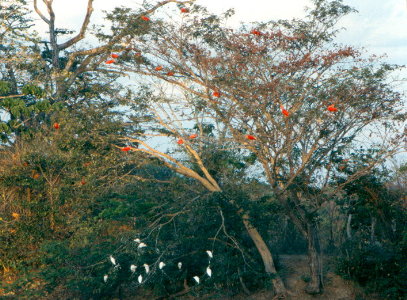
With funding from National Audubon Society and the Disney Foundation, we have undertaken a series of activities within stage 1. Between 27 February and 5 March 2001, we visited Hato Piñero, a private ranch located in the Venezuelan central llanos (Cojedes state, at c.9ºN 68ºW). Roughly 30% of its 80,000 ha are used for cattle grazing, while the rest is in a relatively natural state. The ranch spans a diversity of habitats that range from sparsely wooded flooded savannas through a variety of savanna scrub–forest mosaics, to well-developed gallery and dry forests. Various types of wetland are also found. In general, these are open habitats with good visibility and about as many birds can be identified visually as through knowledge of vocalisations.
To contrast the results from Hato Piñero, on 5–12 April we undertook our second field methods test along the road to the island of Anacoco, in the Cuyuní Basin of eastern Venezuela, very close to the border with Guyana (Bolívar state, at c.7ºN 61ºW). Here, we found dense primary and secondary lowland forest, and a completely different avifauna to that of the drier central llanos. Though these ecosystems hold a diverse and specialised avifauna, the species are far more difficult to detect due to the dense vegetation. Mechanics of bird detection were very different here and a very high proportion of species and individuals were detected on sound alone. This constitutes a major challenge for field workers.
In February 2002, we plan to visit the montane cloud forests of Yacambú National Park (Lara state, at c.10ºN 70ºW), an example of habitats intermediate between the open llanos landscapes and closed forests of southern Venezuela. This will conclude the necessary field work for the NeoMaps protocol.
By the end of 2002, we expect to synthesise our findings into a concrete methodological proposal for the first Venezuelan Ornithological Survey, to be carried out in mid-2003 (stages 2–4 above).
The expansion of NeoMaps to other countries and other stages of the project will be developed from 2004 onwards.
As in the case of the North American Breeding Bird Survey, the Audubon Christmas Bird Counts1, and Atlas of Breeding Birds in Britain and Ireland4, this initiative relies heavily upon volunteer support. The future of the project, particularly all aspects of long-term population monitoring, requires the establishment of a group of volunteer amateur or professional ornithologists from the Neotropics and other regions of the world. One of the major strengths of the project is that it actively encourages amateur bird enthusiasts to become involved in worthwhile conservation work, permits them to increase their experience of Neotropical birds and provides an opportunity to receive field training while at the same time generating scientifically rigorous data.
We encourage readers to participate in this exciting initiative. Volunteers with considerable experience of Neotropical avifaunas and the ability to identify a large number of Neotropical birds by vocalisations are especially sought. If you are interested in becoming involved with NeoMaps and potentially able to take part in fieldwork during 2002, please contact us.
References
1. Butcher, G. S. (1990) Audubon Christmas Bird Counts. In: Sauer, J. R. & Droege, S. (eds.) Survey designs and statistical methods for the estimation of
avian population trends. Washington DC: US Fish & Wildlife Service, Biol. Rep. 90 (1).
2. Bystrak, D. (1981) The North American Breeding Bird Survey. In: Ralph, C. J. & Scott, J. M. (eds.) Estimating numbers of terrestrial birds. Studies in Avian Biology 6. Lawrence, Kansas: Cooper Ornithological Society.
3. Droege, S. (1990) The North American Breeding Bird Survey. In: Sauer, J. R. &
Droege, S. (eds.) Survey designs and statistical methods for the estimation of avian population trends. Washington DC: US Fish & Wildlife Service, Biol. Rep. 90 (1).
4. Gibbons, D. W., Reid, J. B. & Chapman, R. A. (1993) The new atlas of
breeding birds in Britain and Ireland: 1988–1991. London, UK: T. & A. D. Poyser.
5. Sauer, J. R., Hines, J. E., Thomas, I., Fallon, J. & Gough, G. (2000) The North American Breeding Bird Survey, results and analysis 1966–1999. Version 98.1. Laurel, MD: USGS Patuxent Wildlife Research Center. (Available on the World Wide Web: http://www.mbr.nbs.gov/bbs/bbs.html.)
Jon Paul Rodríguez, Centro de Ecología, Instituto Venezolano de Investigaciones Científicas (IVIC), Apartado 21827, Caracas 1020-A, Venezuela. E-mail: jonpaul@ivic.ve.
Christopher J. Sharpe, PROVITA, Apdo. 47552, Caracas 1041-A, Venezuela. E-mail: sharpebirder@gmail.com.